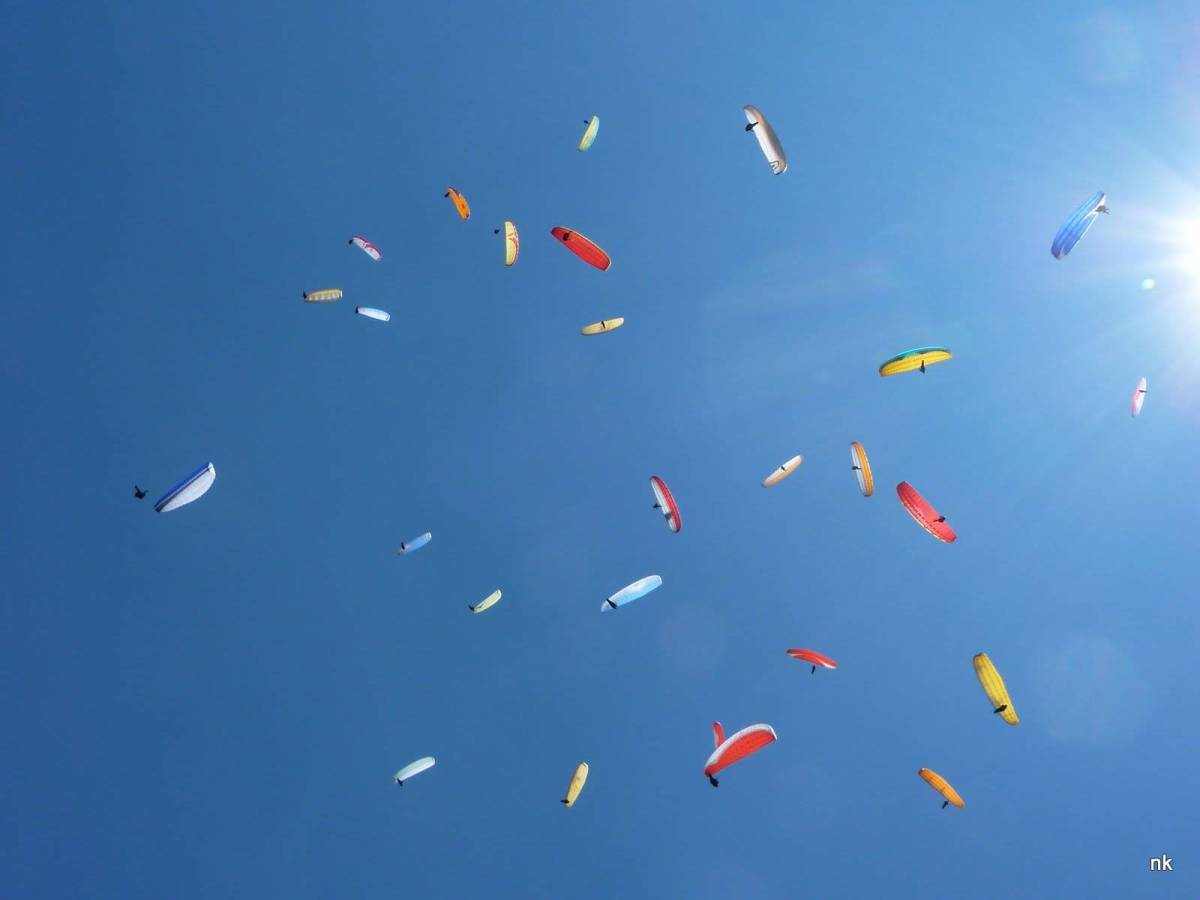
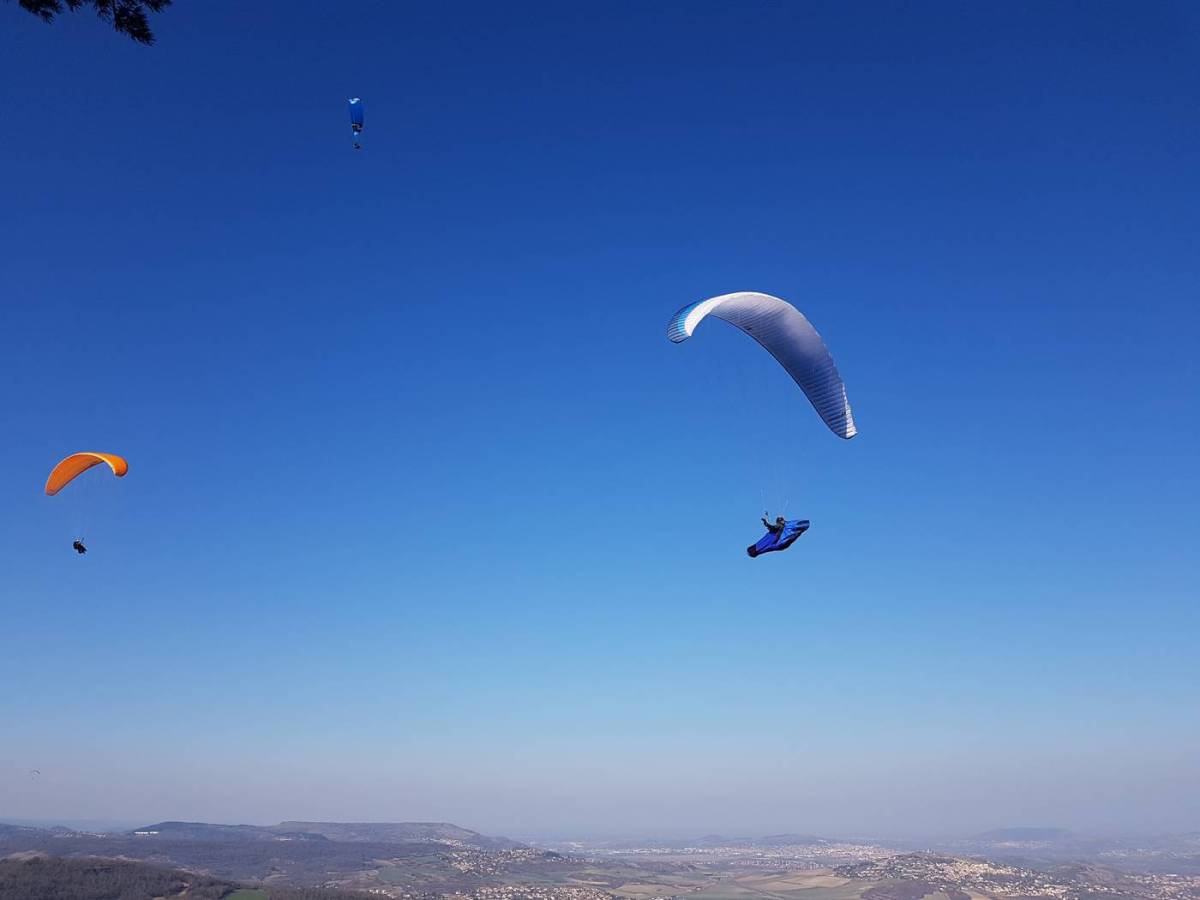
The skies are becoming increasingly crowded with free flight enthusiasts every year. Popular sites in summer, busy thermals at weekends, cross-country conditions that bring pilots together on the same routes... In this context, knowing and respecting the rules of priority in flight is no longer just a regulatory obligation: it is a vital necessity.
The good news? Most paragliding collisions are preventable. They are rarely the result of fate, but almost always of a lack of knowledge of the rules, inattention, or a lack of anticipation. This reminder is for all pilots, beginners and experienced alike.
These rules were not invented by clubs or federations: they are derived from international aviation regulations (ICAO standards) and French air traffic regulations. They apply to all aircraft, motorized or not, including paragliders.
Translated with DeepL.com (free version)
The rule that overrides all others: Every aircraft pilot must avoid collision as much as possible
This rule might almost seem obvious, as it appears so natural, yet it is of great importance because it governs all the others. In all the rules that follow, one pilot will be designated as having right of way over the other. But this fundamental rule of avoiding collision at all costs never goes away, and the pilot with right of way must still avoid and alter their course if possible. It therefore seems essential to remove from pilots' minds the idea that having right of way means they can impose it on others. Given the stakes involved in right of way and in order to keep flying enjoyable, even in crowded skies, pilots should operate in a "everyone makes an effort for others" mindset rather than a "sometimes I assert my right of way, sometimes I yield it" approach.
Fundamental right of way rules
The least maneuverable aircraft has right of way
This fundamental principle is the cornerstone of all aviation regulations. A paraglider, due to its low speed and dependence on weather conditions, is far less maneuverable than a light aircraft. It therefore has right of way over powered aircraft. However, this priority is not absolute: it fits within a precise hierarchy.
Aircraft hierarchy
Here is the order of priority, from highest to lowest:
- Balloons (very limited control, almost no avoidance capability)
- Gliders, paragliders, hang gliders, powered paragliders
- Microlights (ULM)
- Powered light aircraft
In practice, among paragliders, you are all at the same level of the hierarchy. This is why the rules specific to free flight are so important: they govern your interactions with one another.
An aircraft in distress always has right of way
Regardless of the situation, an aircraft in an emergency (malfunction, injured pilot, reserve parachute deployed...) has right of way over all others. If you identify a pilot in difficulty, clear the area without hesitation and alert emergency services or other pilots if you can.
Rules in practice at the site
In a thermal: the first one in sets the direction
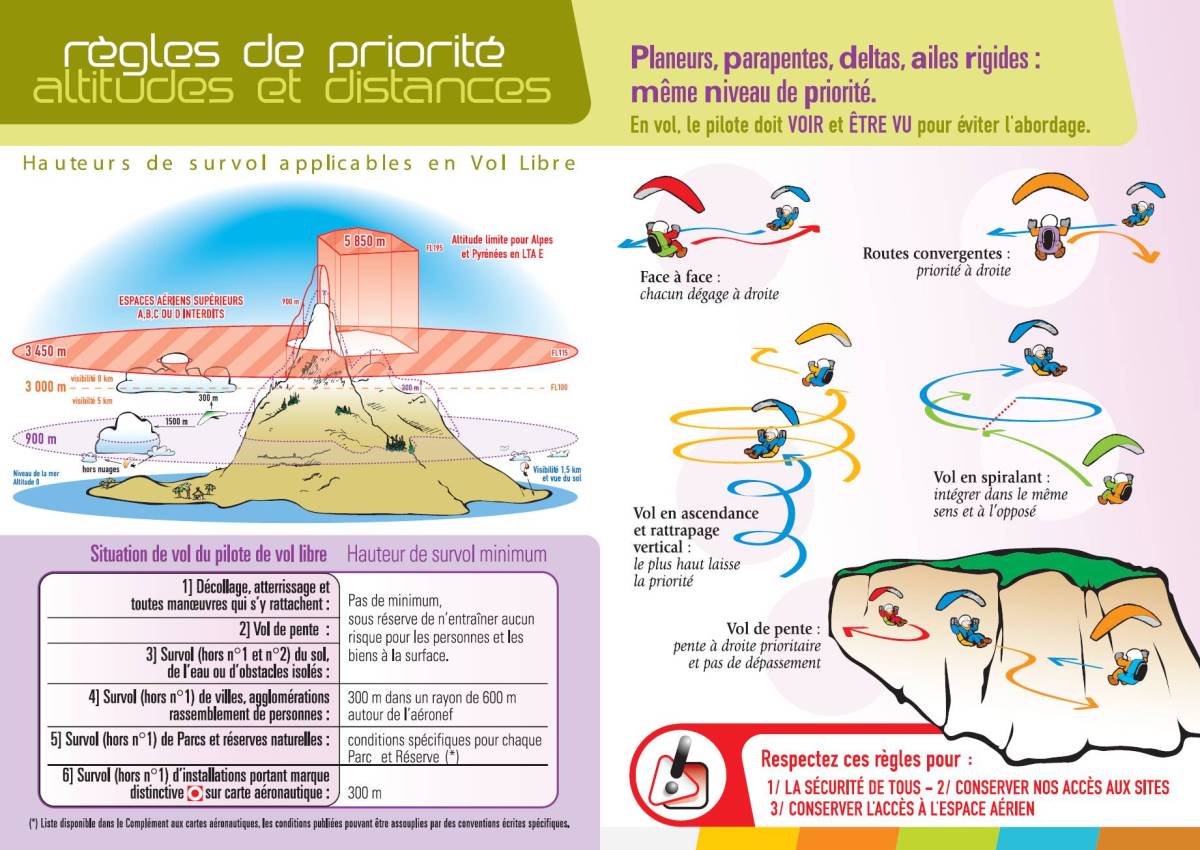
When you join a thermal where other pilots are already circling, you must adopt their direction of rotation without question. The first pilot to enter the thermal sets the rule. Everyone else follows, full stop.
Even if turning the other way might seem more efficient, mixing directions in a thermal is a serious accident risk. The rule is simple, it needs to stay simple, and it applies every single time.
In a thermal: make room for the climbing pilot
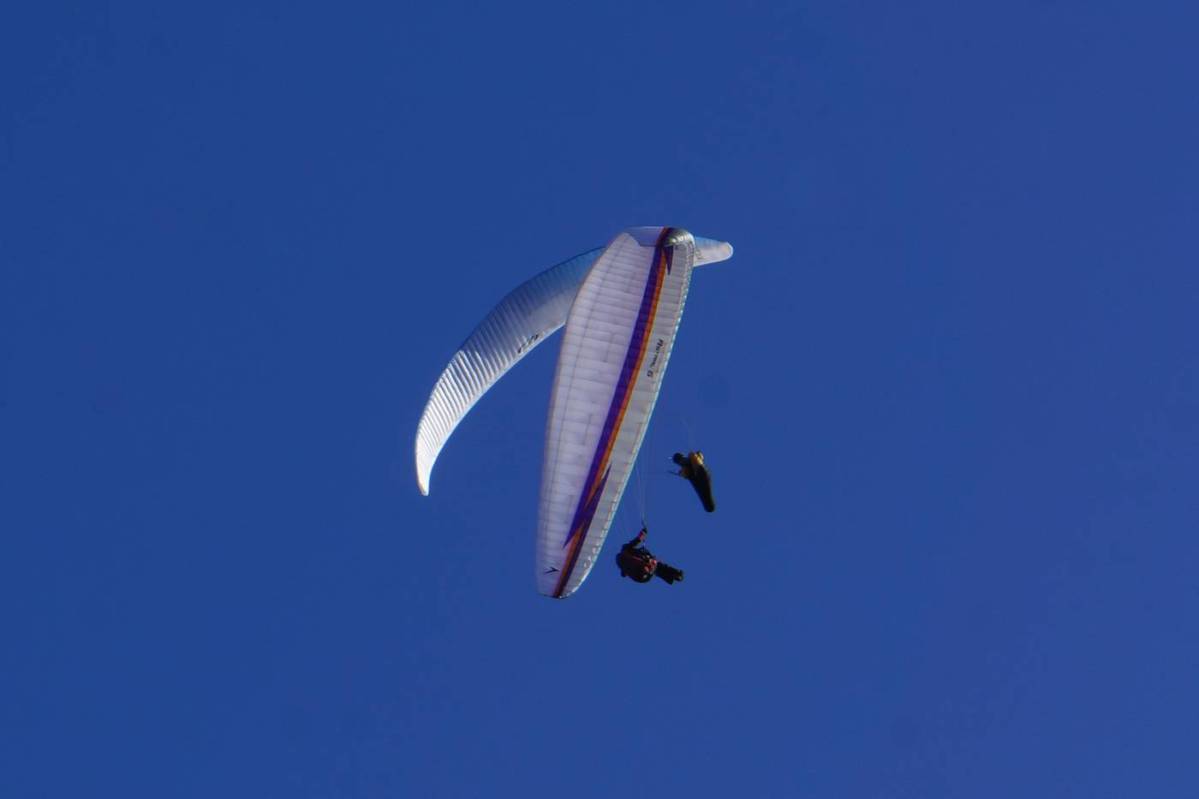
This rule is less well known, but just as important. If a pilot below you is climbing faster than you in the thermal, you must give way. Why? Because the pilot below cannot see what is happening above their wing. They are blind to your presence.
It is up to the pilot above — who has a much better view downward — to manage the vertical spacing. Anticipate, widen your spiral, or temporarily leave the thermal if needed. Never rely on the pilot below to avoid you.
Head-on crossing: move right
If you meet another pilot head-on during a glide, the rule is universal in aviation: each pilot moves to their right. Simple, memorable, effective. Make it a reflex.
Ridge soaring: right of way goes to the pilot hugging the ridge
This is a fundamental rule of ridge soaring, often misunderstood. The pilot with the cliff on their right cannot move in that direction without risking hitting the terrain. They therefore have right of way.
The pilot coming from the opposite direction has open space on their right. It is therefore their responsibility to move aside — early enough and widely enough — to let the other pass. A minimal clearance is not enough: paragliders have a wingspan, wingtip vortices, and a safety margin that must be respected.
⚠️ Key rule: when ridge soaring, if the cliff is on your right, you have right of way. If open air is on your right, you give way.
Leaving the launch: make room for the pilot taking off
This rule is often overlooked, yet it is essential at busy sites. A pilot in the process of taking off is in a critical phase: their wing has just inflated, they are not yet stable, their speed is low and their ability to maneuver is very limited. They can neither stop nor easily change direction.
Pilots already airborne and flying near the launch must clear the exit zone. Do not fly low past the launch, do not hug the terrain just above the takeoff point, and always anticipate that a pilot could take off at any moment.
In practice: if you see or hear a pilot preparing to take off, move away far enough to give them a comfortable margin.
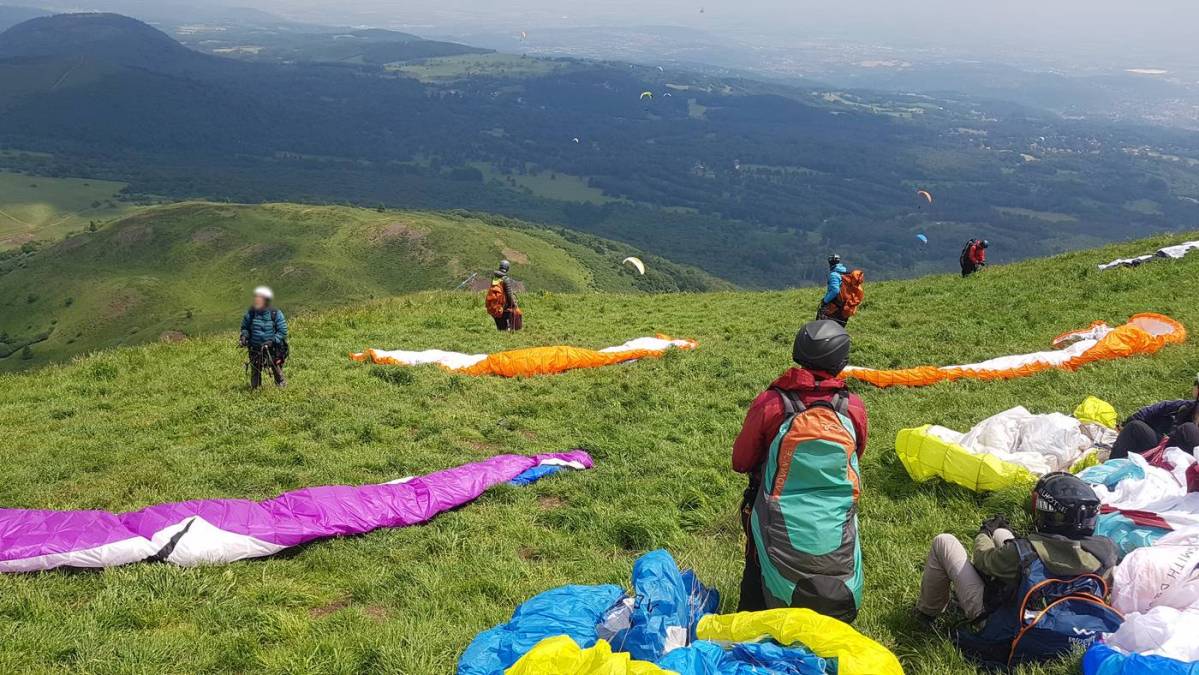
Priority on the launch area
When waiting your turn to take off, right of way always goes to the pilot in front of you — even if they are taking a long time or attempting multiple inflation runs to get their wing up properly.
3. The landing circuit and landing
Right of way goes to the lowest pilot
In the landing area, the rule is clear: the lowest pilot, on final approach, has right of way. They have committed to their path, their trajectory is fixed, and their margin to maneuver is very limited. All other pilots, higher up, must adapt to them.
If you are on a downwind leg or base leg and a pilot is already on final below you, never cut across their path. Do an extra circuit or wait.
Never cut across a final approach
Cutting across another pilot's final approach is one of the most serious mistakes you can make at any site. A pilot on final has almost no room to maneuver. A collision at low altitude can be fatal.
Group landing: managing overtakes
When several pilots are landing at the same time, a faster pilot catching up with another must not pass in front of them from below. If you overtake another pilot, do so from the side and make sure they have seen you. Call out verbally if needed.
Once landed: right of way for incoming pilots
Once on the ground, you must check whether other pilots are on final approach. If so, collapse your wing as quickly as possible. This is often the case during mass landings following a sudden end to thermal activity, or at very busy sites.
The same applies if you are kiting or ground-handling: always give right of way to any pilot on approach.
Specific situations
Paraglider and hang glider crossing
Paragliders and hang gliders share the same sites, but their flight characteristics are very different. A hang glider is generally faster and more maneuverable in transition. The basic rules apply (move right in a head-on situation, right of way to the least maneuverable), but always anticipate: a sudden collapse on your part can catch a hang glider pilot completely off guard.
Birds: vultures, eagles and others
In the mountains, sharing the sky with birds of prey is an everyday reality. Griffon vultures in particular are happy to share thermals with paraglider pilots. They are large gliders and, in the natural order of things, they usually know to move aside.
That said, a bird does not know the rules of the air. Do not get too close, keep your distance, and be aware that a collision with a large bird of prey can cause a wing collapse. Stay calm and anticipate.
Powered aircraft
Light aircraft, microlights, helicopters... you may encounter them, especially on cross-country flights or near airfields. Always respect airspace boundaries and local procedures.
One specific and often underestimated hazard involves rotary-wing aircraft. Their rotors generate wake turbulence that can be extremely violent and persist for several minutes after they have passed. This turbulence drifts with the wind. If you see or hear a helicopter nearby, do not fly straight into the area it has just crossed: wait, observe, and proceed with caution.
Good habits and communication
Always anticipate, never react in a rush
Mid-air collisions happen in a matter of seconds. At the speeds we fly, there is no time to think once the situation is already critical. The only effective solution is to anticipate. Look ahead, look around, identify other pilots before they become a problem. Make a habit of regularly scanning the full horizon.
A simple rule: if you are not sure you have right of way, give it up. If you are not sure about the situation, clear the area. Caution is not weakness.
Radio communication at equipped sites
Many sites have a shared radio frequency. Use it wisely: announce your launch, your intention to land, or an emergency. But keep exchanges short and to the point. The radio is not a tool for in-flight chat, and a pilot distracted by a radio conversation is a pilot less aware of their surroundings.
The golden rule
⚠️ Giving way is always better than being right and ending up under your reserve parachute.
In the air, no one is going to settle a dispute. If an ambiguous situation arises, the right call is almost always to move aside. Your ego is not worth risking your life or another pilot's.
In case of accident, emergency services always have priority!
When a helicopter arrives on site for an intervention, its priority is absolute:
- If you are airborne, clear the area to ease its approach and land as soon as possible, taking care to avoid its wake turbulence as much as you can.
- If you are at the launch, pack your wing away and wait until the intervention is over, even if it takes a long time. The rescue helicopter must be able to take off again at any moment.
Conclusion
These rules represent the strict minimum for flying safely and working towards your paragliding licence. They are the practical expression of a fundamental principle: in the air, the coexistence of several aircraft in the same space requires common rules, understood and respected by everyone.
A pilot who does not know the right of way rules is a danger to themselves and to others. A pilot who knows them but does not apply them is an even greater one.
Talk about these rules with those around you, remind the beginners you fly with, and include them in your pre-flight briefings. Safety in the air is everyone's responsibility.
Happy flying, and stay safe! 🪂