Want to know more about parakites? The Freedom Parapente team tells you everything you need to know about this new sport and these breathtaking machines!
Article Table of Contents :
What are parakites? Definition and flight mechanics
Parakites are not a mix between a paraglider and a kite! They are modified paragliding or paramotor wings whose pitch can be changed in flight by raising the hands.
The brakes deform the trailing edge of the wing to create a flap, as on all paragliders, but they are also pulley-rigged with the rear risers, which allows the latter to be lengthened when the hands are raised. The wing then becomes more nose-down, generating a diving trajectory and a significant increase in speed.
The kinetic and potential energy accumulated during this diving phase can then be used to perform a strong climb, or flare, over a long distance by lowering the hands.
The so-called “neutral” position is clearly identified on all parakites. It is generally with the hands at shoulder level. This is the position that provides the best glide ratio.
Above this position, the wing accelerates with a diving trajectory.
Below it, the speed decreases progressively until approaching the stall point, as with a classic paraglider wing.
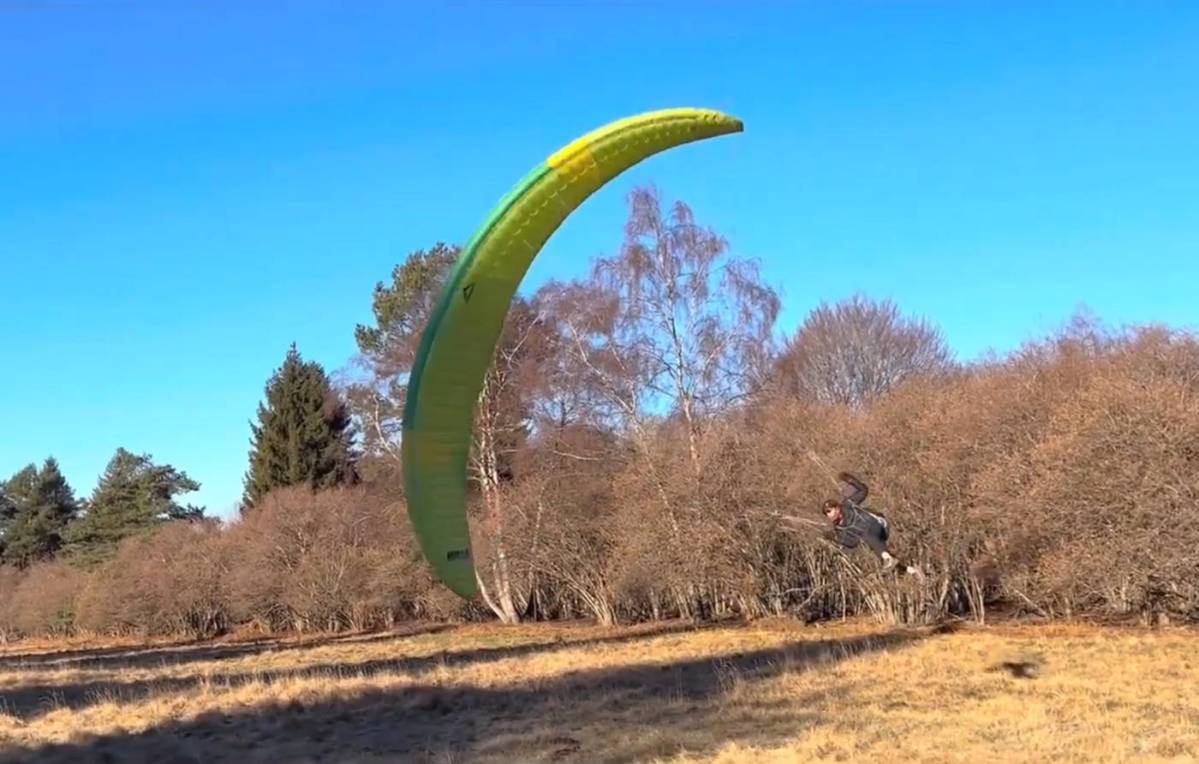
To reduce the risk of a collapse, parakites are strongly junctioned and designed to provide a strong reflex effect. It is very difficult to make them collapse. Many inflation videos show pilots deliberately pulling on the front risers: the wing moves forward and descends without collapsing. If you try the same with a classic paraglider, the difference is immediately noticeable (these exercises should only be done on the ground, of course).
⚠️ Warning: even though collapses are harder to trigger, an in-flight collapse is still possible. It will simply occur less frequently than with a classic paraglider.
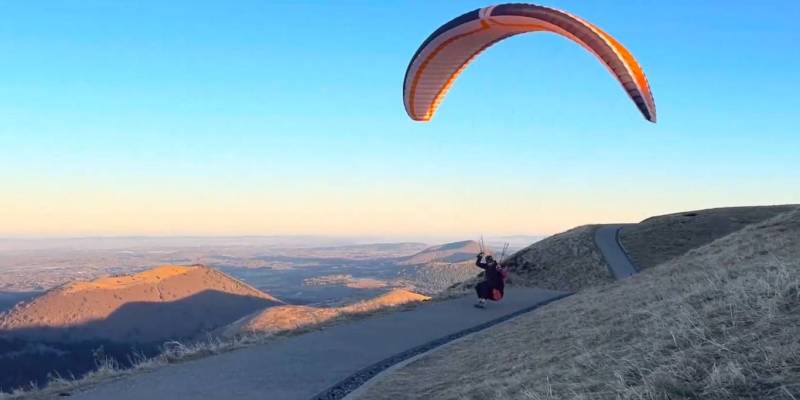
Follow us in parakite in this video during a sunrise at Puy de Dôme!
What are parakites used for? Sensations, terrain play, and piloting pleasure
Parakites are above all incredible generators of fun and thrilling sensations. Personally, after more than 20 years of free flight, I still feel the excitement of my first flights.
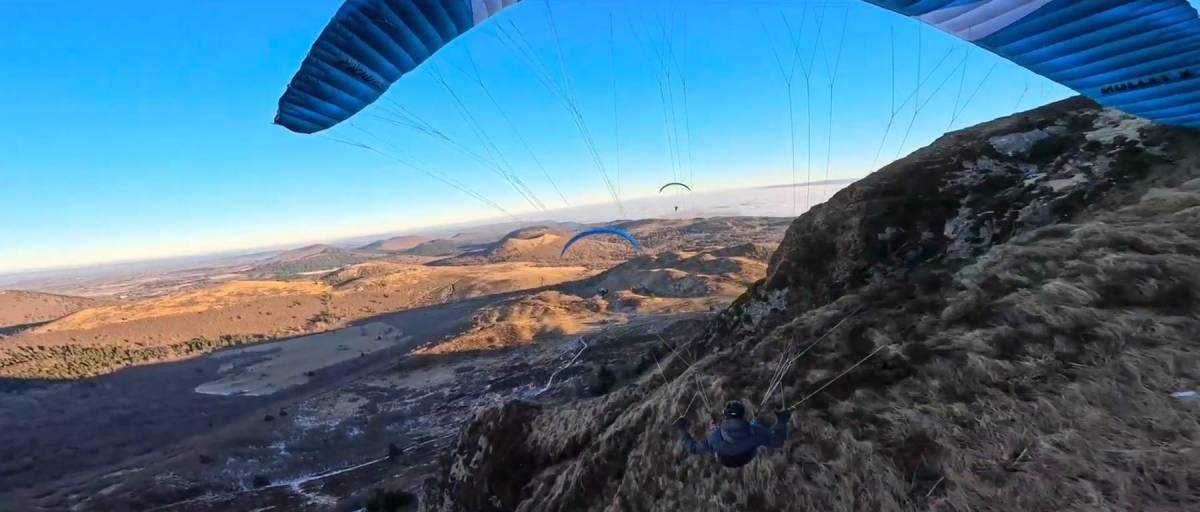
The ability to dive intentionally greatly increases the options for playing with the terrain and staying close to the ground. Parakites are therefore perfectly suited for:
- descending mountains while staying close to the terrain
- practicing dynamic soaring
- playing with low and fast trajectories
Gaining speed also transforms landing phases: you arrive quickly and flare over a very long distance, which provides particularly exhilarating sensations.
You’ve understood, I’m super enthusiastic! But there are also downsides to this pleasure.
What can't you do with parakites? Limits and practice constraints
First, the hand position, often under tension, generates a significant physical effort. Flying fast and for long periods can become tiring. This remark is not unanimous among my colleagues: everyone will have their own experience.
However, the concentration required to fly quickly and close to the ground is undeniable and can prove exhausting over time.
Flying in thermal or turbulent conditions is not enjoyable and is even discouraged by manufacturers. Parakites are primarily designed for laminar air masses and dynamic flights close to the terrain.
Who are parakites for? Required level and pilot profile
In my opinion, parakites are more demanding machines than a standard paraglider. They fly faster, dive more, and require a fine reading of the terrain and air mass, which makes piloting them more complex.
It seems reasonable to have at least a level equivalent to a pilot license before considering trying these machines.
Under very specific conditions — rarely visited sites, laminar air near the coast — it might be possible to start earlier, but this does not seem either relevant or sustainable.
Parakites are also aimed at pilots who are able to manage their limits. They encourage an engaged and extremely enjoyable practice, but where clear-headedness regarding risk-taking must be perfectly maintained.
Which parakite size to choose based on your practice?
Unlike a classic paraglider, where the size is mainly chosen based on the maximum take-off weight (MTOW), the choice of a parakite also depends on the intended use.
- For mountain descents close to the ground, on steep terrain, a rather small or even very small size is preferred to achieve maximum speed.
- Conversely, for staying in soaring flight in moderate winds (around 15 to 20 km/h), a larger size will be preferable.
If you are hesitating between two sizes and this is your first parakite, I recommend choosing the larger size. The change in speed and behavior compared to a classic paraglider will already be significant.
However, for pilots accustomed to mini-wings or small-surface acro wings, a more radical choice can be considered.
Finally, it is important to note that behavior varies greatly depending on brands and models. For example, a Flow Paragliders Mullet X 17.5 m² has a character as radical as a Flare Moustache 1 at 15 m².
Safety and usage framework for parakites
Even though parakites benefit from a strong reflex effect and high resistance to collapses, they should not be considered “forgiving” wings. The high speed, proximity to the ground, and stored energy require:
- a thorough site analysis
- appropriate safety margins
- perfect anticipation of flight trajectories
Training, supervision, and structured progression remain essential to safely operate these wings.
Parakite, classic paraglider, and mini-wing: what are the differences?
The parakite differs from a classic paraglider by its ability to significantly change its pitch in flight, without using a traditional speed bar.
Compared to a mini-wing, it often offers:
- better glide in the neutral position
- a wider speed range
- more directional behavior at high speed
Each category follows a different practice logic, and the parakite occupies a unique place between the paraglider, the mini-wing, and speed flying.
So, which parakite model should you choose?
The Freedom Parapente team has had the opportunity to test several different machines. We will soon publish a detailed comparison of the models we tried, to help pilots make an informed choice based on their skill level, playground, and objectives.
See you soon 🪂